Context
meaning.love
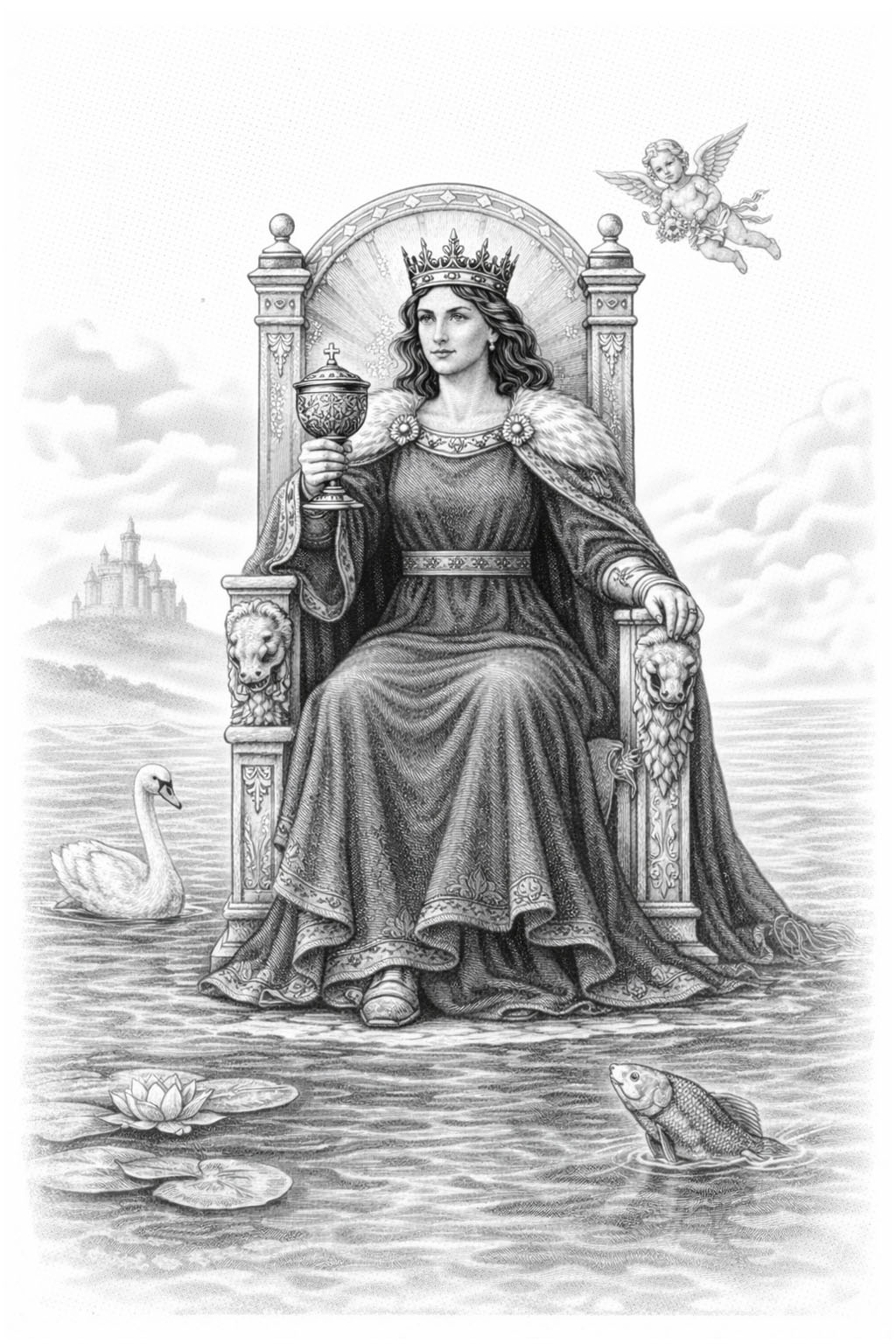
Queen of Cups (Cup Queen) in the context of love describes an emotional maturity centered on empathy, receptivity, and inner attunement. She represents someone who feels deeply, values emotional honesty, and approaches relationships with compassion and patience. In readings about love, this card highlights sensitivity to another’s needs, the ability to hold emotional space without judgment, and an intuitive understanding of unspoken dynamics. It can indicate a partner or aspect of the querent that prioritizes emotional connection, nurturing, and supportive presence.
Analytically, the Queen of Cups also signals the importance of balancing feeling with clarity. Her strengths include emotional intelligence, caregiving, and the capacity to soothe conflict through calm listening. Her vulnerabilities include over-identifying with a partner’s emotions, difficulty setting boundaries, or retreating into moodiness rather than communicating needs directly. For study or application, consider how empathy operates in your relationships: when it fosters mutual support and when it risks enabling dependency or self-sacrifice. Cultivating clear expression of feelings, healthy boundaries, and self-care practices helps preserve the Queen’s compassionate strengths while minimizing her shadow tendencies.
meaning.job
Queen of Cups (Cup Queen) in a career context emphasizes emotional intelligence, empathy, and an attuned, reflective approach to professional life. This archetype represents someone who brings sensitivity, strong listening skills, and an ability to read interpersonal dynamics into their work. Rather than pushing through conflict with force or sheer ambition, the Queen of Cups favors diplomacy, support, and fostering a harmonious atmosphere, often becoming a trusted confidante, mentor, or mediator within a team.
In practical terms, the card signals strengths in roles that rely on emotional labor, client care, counseling, human resources, team facilitation, creative development, or any position where understanding people and motivating through empathy are valuable. It highlights the capacity to create psychologically safe environments, to anticipate morale shifts, and to translate intuitive perceptions into thoughtful guidance. Decisions informed by this perspective tend to weigh human factors and long-term well-being alongside technical concerns.
At the same time, the Queen of Cups points to possible pitfalls: over-identification with others’ problems, difficulty setting boundaries, avoidance of necessary confrontation, and a tendency toward emotional overload or indecision. These patterns can lead to burnout or to being overlooked for leadership roles that require firmer stances.
For professional development, the educational takeaway is to cultivate a balance between emotional attunement and clear structure. Strengthen assertiveness and conflict-resolution skills so empathy does not become passivity; pair intuitive insights with evidence and documented plans so decisions are both humane and accountable; and adopt regular practices for boundary-setting and self-care to sustain effectiveness. When emotional wisdom is combined with practical systems, the qualities associated with the Cup Queen become a durable leadership asset rather than a vulnerability.
meaning.finance
In a financial context the Queen of Cups represents an approach to money that is guided by emotional intelligence, empathy and an appreciation for non-material values. It suggests decisions made with care for other people’s needs, sensitivity to the atmosphere in partnerships and a preference for investments or expenditures that nourish wellbeing, creativity or relationships rather than simply chase profit. This card can point to income derived from caring professions, arts, counseling or any work that relies on intuition and interpersonal skill, or to financial choices motivated by compassion, family responsibilities or long-term security for loved ones.
Analytically, the Queen of Cups highlights strengths such as patience, listening, and the ability to read subtle signals in negotiations or joint finances, which can be an asset in relationship-based financial arrangements. It also carries cautions: an overly emotional stance can lead to excessive generosity, blurred boundaries, vulnerability to manipulation, or avoidance of difficult but necessary fiscal decisions. For practical financial management, the card advises balancing empathy with clear boundaries and objective analysis—complementing intuitive judgement with budgeting, documentation and external advice when needed. Ultimately it frames money as a resource to be stewarded with care, sensitivity and a measured combination of heart and prudence.
meaning.family
The Queen of Cups in a family context represents an emotionally attuned, compassionate presence—someone who observes, listens, and responds with empathy. This figure is often associated with caregiving roles, whether a parent, grandparent, or any family member who creates emotional safety and models emotional intelligence. Attention is paid to feelings, nonverbal cues, and the subtle dynamics that influence how family members relate to one another.
Interpreting this card analytically involves noting patterns of sensitivity and emotional availability. It can point to a family culture where emotions are validated and nurtured, where communication is gentle and reflective rather than confrontational. It also highlights an intuitive approach to problems: decisions and interventions are guided as much by feeling and understanding as by logic.
The Queen’s presence also brings potential complications. Excessive protectiveness, boundary blurring, emotional overinvolvement, or difficulty managing one’s own moods can create dependency or inhibit others’ autonomy. Similarly, an emphasis on harmony may lead to avoidance of necessary conflicts and unspoken resentments. These shadow tendencies are part of a balanced reading: the same emotional attunement that fosters healing can, if unguarded, enable enmeshment.
From an analytical standpoint, consider how caregiving labor, emotional labor, and mutual support are distributed within the family. Observe whether emotional needs are acknowledged and reciprocated, and whether members have space to develop resilience. The Queen of Cups invites attention to cultivating both compassion and clear boundaries, to ensure that empathy sustains healthy relationships rather than becoming a vehicle for exhaustion or caretaking imbalances.
meaning.mind
When the Queen of Cups appears in a reading focused on psychological state, it signals an inward-oriented emotional maturity and a rich inner life. This archetype is characterized by a high degree of emotional attunement: awareness of subtle feelings, the ability to sense others' moods, and a strong capacity for empathy. Cognition and affect are tightly interwoven; intuition and imagination play a central role in how experience is processed, and responses are often guided by nuanced, nuanced affective cues rather than purely rational analysis.
This state tends toward receptivity and care. There is an inclination to nurture oneself and others, to hold difficult emotions with patience, and to create a safe inner container for vulnerability. At the same time, sensitivity can carry vulnerabilities: boundary permeability, emotional enmeshment, or a tendency to absorb others' distress without clear differentiation. When overwhelmed, the Queen of Cups quality may retreat into fantasy, idealization, or dissociative soothing strategies rather than assertive problem-solving.
From a psychological-developmental perspective, this card points to strengths in emotional intelligence — empathy, reflective capacity, and a capacity for compassionate self-observation — alongside potential areas for growth such as establishing clear limits, tolerating affective intensity without overidentification, and translating intuitive insight into grounded action. Therapeutic or reflective practices that cultivate emotional literacy, somatic grounding, and secure boundaries tend to support integration of this quality. Creativity, dreamwork, and expressive arts can be productive outlets for the Queen of Cups' inner richness, offering a method for transforming feeling into symbolic, consciously processed material.
In summary, the Queen of Cups describes a psyche that is emotionally attuned, empathetic, and imaginative, with both the resources to hold inner experience compassionately and the challenges of maintaining differentiation and practic
meaning.soul
In the psychological register, the Queen of Cups represents a state of emotional attunement marked by receptivity, depth of feeling, and a reflective inner life. She embodies an ability to notice subtleties in mood and relationships, to name and hold complex emotions, and to respond with measured compassion rather than reactivity. As a description of current affect, the card points to empathy, intuitive awareness, and a tendency to prioritize emotional connection and care—both toward oneself and others.
When balanced, this state supports clear inner listening, creative imagination, and the capacity to offer steady emotional presence without becoming overwhelmed. It also implies a degree of emotional intelligence: understanding motivations, sensing undercurrents, and integrating feeling with thought. In less integrated expressions, the same qualities can skew toward over-identification with others’ feelings, moodiness, withdrawal, or using imagination to avoid practical matters. There may also be blurred boundaries or difficulty voicing needs.
As an analytical prompt, the Queen of Cups invites attention to how feelings are processed and contained. Observing patterns of self-soothing, dependency, or avoidance can clarify whether sensitivity is serving adaptive regulation or fostering enmeshment and exhaustion. Practices that cultivate awareness of boundaries, somatic grounding, and reflective expression tend to support a more resilient, centered emotional stance consistent with the card’s mature side.