Context
meaning.love
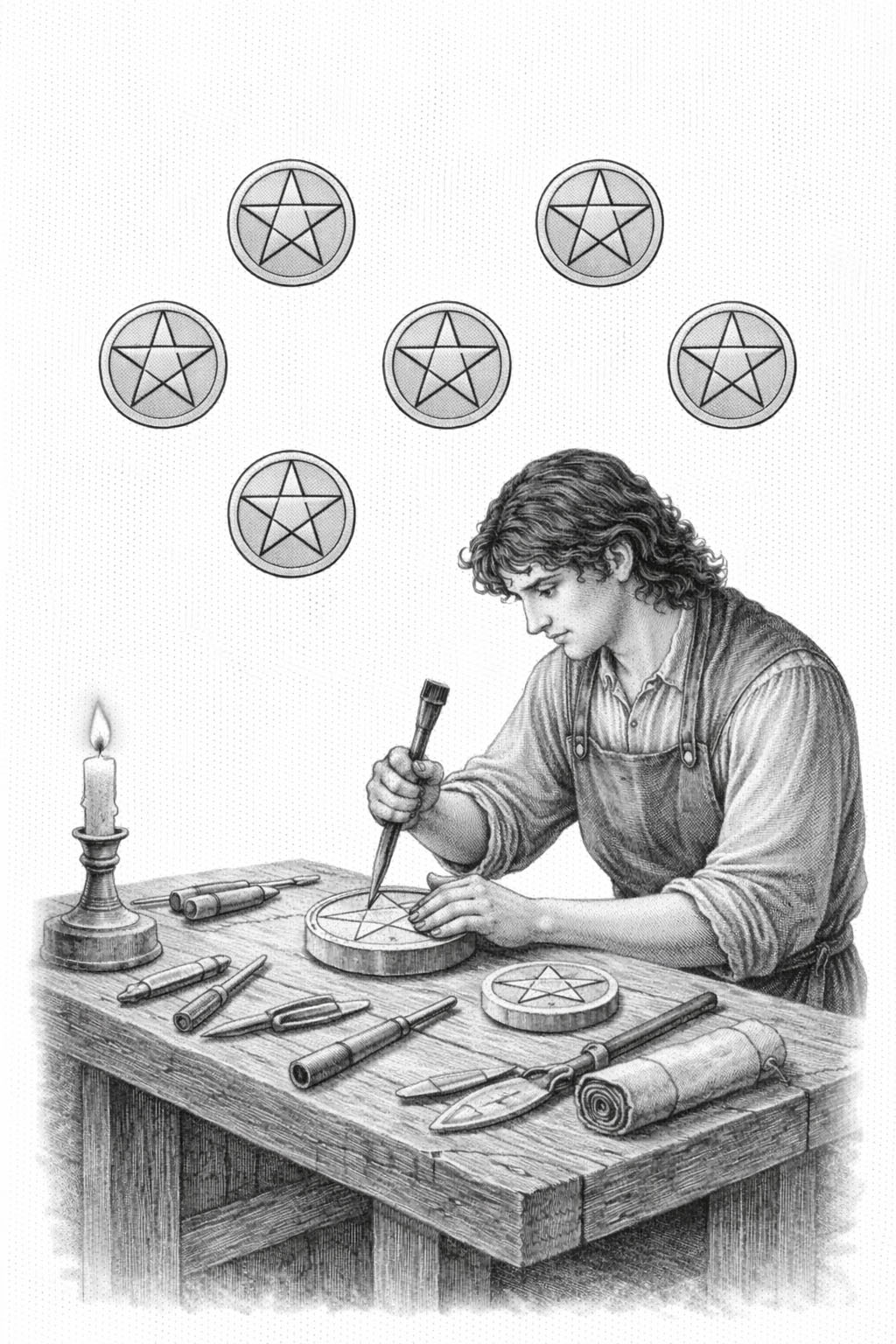
The Eight of Pentacles symbolizes focused effort, skill development, and the disciplined application of time and attention. It emphasizes practice, attention to detail, and a workmanlike approach to mastery rather than quick results or romantic idealism. The card is about process, steady improvement, and the value of repetition in building competence.
Applied to matters of partnership, this card frames love as a craft that benefits from intentional work. It highlights learning how to communicate, developing reliable habits, and attending to the small, concrete behaviors that sustain trust and intimacy. Rather than dramatic gestures, the emphasis is on consistency: showing up, refining how one listens, negotiating everyday responsibilities, and investing in shared routines. It can also reflect personal development that supports healthier relationships: improving emotional literacy, repairing patterns, or building boundaries through practiced effort.
As an interpretive tool, the Eight of Pentacles invites consideration of balance: disciplined effort can produce durable rewards, but it can also become mechanical or overly focused on tasks at the expense of spontaneity and warmth. For study or reflection, consider which aspects of a relationship require steady attention, which skills you or your partner might cultivate, and whether the current approach includes room for both dedicated work and creative, relational play.
meaning.job
In a career context, the Eight of Pentacles points to a focus on skill, craft, and steady improvement. It characterizes periods in which attention to detail, disciplined practice, and a willingness to do the necessary, sometimes repetitive, work are central to professional progress. The card highlights learning through doing: training, apprenticeships, on-the-job refinement, or focused study that builds competence over time rather than relying on shortcuts or sudden breakthroughs.
Analytically, this card emphasizes process over outcome. Quality and consistency are the metrics that define success here. Work habits — punctuality, conscientiousness, methodical problem-solving, and an emphasis on standards — tend to matter more than charisma or risk-taking. In environments where craftsmanship and reliability are valued, this approach strengthens reputation and opens paths to greater responsibility or specialization. The Eight of Pentacles also points to the accumulation of expertise: repetition and refinement produce technical mastery, improved workflow, and an increasingly professional portfolio of work.
At the same time, the card carries caveats. The same focus that builds skill can lead to tunnel vision or a narrow skill set if learning becomes purely routine. There can be a tendency to prioritize perfectionism, which slows progress or creates unnecessary stress. Monotony and isolation are possible when tasks are highly repetitive; without broader perspective or feedback, development can plateau. Additionally, an overemphasis on craftsmanship may neglect relationship-building, strategic thinking, or adaptability—elements that are often important in career advancement.
From a practical standpoint, the Eight of Pentacles encourages deliberate practice paired with reflection. Setting concrete milestones, seeking mentorship or peer review, and documenting accomplishments help translate the work of honing skills into visible career progress. Balancing depth with occasional breadth—adding complementary skills or main
meaning.finance
The Eight of Pentacles in a financial context emphasizes income and stability that arise from disciplined effort, skill development, and attention to detail rather than from speculation or sudden gains. It highlights a process in which steady, repetitive work and the honing of competence produce measurable improvements in earning capacity over time. Financially, this card points to situations where investing in training, refining a craft, improving systems, or increasing efficiency is likely to enhance long-term returns; earnings reflect the level of skill and consistency applied. It also draws attention to the practicalities of budgeting, record‑keeping, and reinvestment of small gains to build a more secure base.
At the same time, the image can signal the risk of becoming confined to routine tasks that, while productive, may limit broader strategic thinking or career mobility if not balanced with planning. It invites assessment of whether time spent on meticulous work produces commensurate compensation, and whether automation, delegation, or negotiation might free capacity for higher‑value activities. For someone building a business or freelance practice, the card underscores the value of setting measurable goals, tracking progress, pursuing certifications or demonstrable outcomes, and documenting work to justify fees. In short, the Eight of Pentacles frames financial matters around craftsmanship, disciplined practice, and incremental improvement, while encouraging a pragmatic review of efficiency, value, and long‑term investment in skills.
meaning.family
The Eight of Pentacles is centered on themes of skill development, steady effort and attention to detail. In general it represents a focus on craftsmanship and the processes through which competence is built: repetition, study, practical application and incremental improvement. It emphasizes the value of work that is conscientious and sustained rather than spectacular or sudden.
In a family context, this card points to the domestic equivalents of that craft ethic. It can indicate that family life is being maintained through disciplined routines, practical caregiving, household labor and the slow accumulation of reliable habits — for example, regular childcare practices, household management, budgeting, or the steady completion of home projects. It also highlights learning and teaching within the family: parenting skills being refined, a partner taking on new responsibilities, or members passing practical knowledge to one another. Because the card foregrounds small, repeated actions, it draws attention to how trust and stability are often created by consistency rather than grand gestures.
At the same time, the Eight of Pentacles highlights potential limitations of an exclusively task-oriented approach. An emphasis on chores, perfectionism or overwork can make day-to-day life feel repetitive and may leave less room for spontaneity, emotional connection or leisure. Read as an analytic prompt, the card invites examination of how effort is distributed in the household, what skills are being developed, and whether the steady labor that underpins family functioning is balanced with space for relationships and rest.
meaning.mind
Pentacles Eight describes a psychological state oriented toward craft, discipline and incremental improvement. The mind is absorbed in procedure and technique; attention narrows to detail, practice and the steady accumulation of competence. Motivation tends to be intrinsic, driven by a desire to refine skills, fulfill standards, and produce work of a particular quality. There is satisfaction in repetition and clear progress markers, and a preference for structure, routine and measurable goals. On the shadow side this orientation can harden into rigidity or tunnel vision: an excessive focus on the task may dull broader perspective, limit spontaneity, or lead to fatigue and social withdrawal. In psychological terms the card points to a methodical temperament, a strong work ethic, and a learning mindset, but it also invites awareness of perfectionist tendencies and the need to balance focused effort with reflection, rest and relational engagement.
meaning.soul
As a state of mind, the Eight of Pentacles represents focused, methodical engagement with a task or craft. It embodies an attitude of disciplined learning: attention to detail, repetition aimed at improvement, and a willingness to invest time and effort to develop competence. Mentally, this card characterizes someone who is absorbed in process work, comfortable with routine, and motivated by measurable progress rather than sudden insight.
Emotionally, this stance often brings quiet satisfaction and a grounded sense of purpose; small achievements are noticed and accumulate into discernible skill. There can be a pragmatic pride in workmanship and a preference for concrete, tangible outcomes. At the same time, the mentality can incline toward narrowing attention to technical concerns, prioritizing mastery over spontaneity or broader meaning.
On the shadow side, this state of mind may manifest as perfectionism, over-identification with productivity, or social withdrawal during periods of intense practice. It can also produce anxiety about not measuring up or an inclination to neglect rest and perspective in pursuit of incremental gains. Recognizing these tendencies allows for a more balanced approach: maintaining dedication to craft while allowing space for creativity, recovery, and reflection on larger goals.
Viewed educationally, the Eight of Pentacles highlights the psychological dynamics of deliberate practice, the trade-offs between depth and breadth, and the value of consistent effort for building competence. It invites an examination of how discipline serves personal growth and where it might limit flexibility or well-being.