Context
meaning.love
The Two of Pentacles in a love context highlights dynamics of balance, adjustment and practical juggling. It describes a relationship or romantic situation where competing demands — work, family responsibilities, social life, personal projects — require continual readjustment. Rather than signaling a single, decisive feeling, this card points to movement: partners are adapting to shifting circumstances, negotiating priorities, and trying to keep several things in motion without dropping the essentials.
Emotionally, the card suggests flexibility and a willingness to cooperate, but also the risk of superficiality if adaptation becomes mere patchwork. If attention is split across many obligations, intimacy can feel intermittent or transactional; the capacity to be present may ebb and flow with external pressures. Conversely, when handled consciously, the Two of Pentacles can indicate a playful responsiveness, the ability to rebalance quickly after disruptions, and practical problem-solving that sustains the relationship through change.
For a constructive reading, focus on where energy is allocated and how decisions are coordinated. Communication about needs, timelines and boundaries helps transform juggling into shared planning rather than avoidance. Observing patterns of disruption and creating simple routines or agreements can reduce chronic instability. Consider whether flexibility is being used to accommodate both partners’ needs or to postpone deeper conversations. The card invites an assessment of logistical realities alongside emotional ones and encourages pragmatic strategies to maintain connection while managing life’s demands.
meaning.job
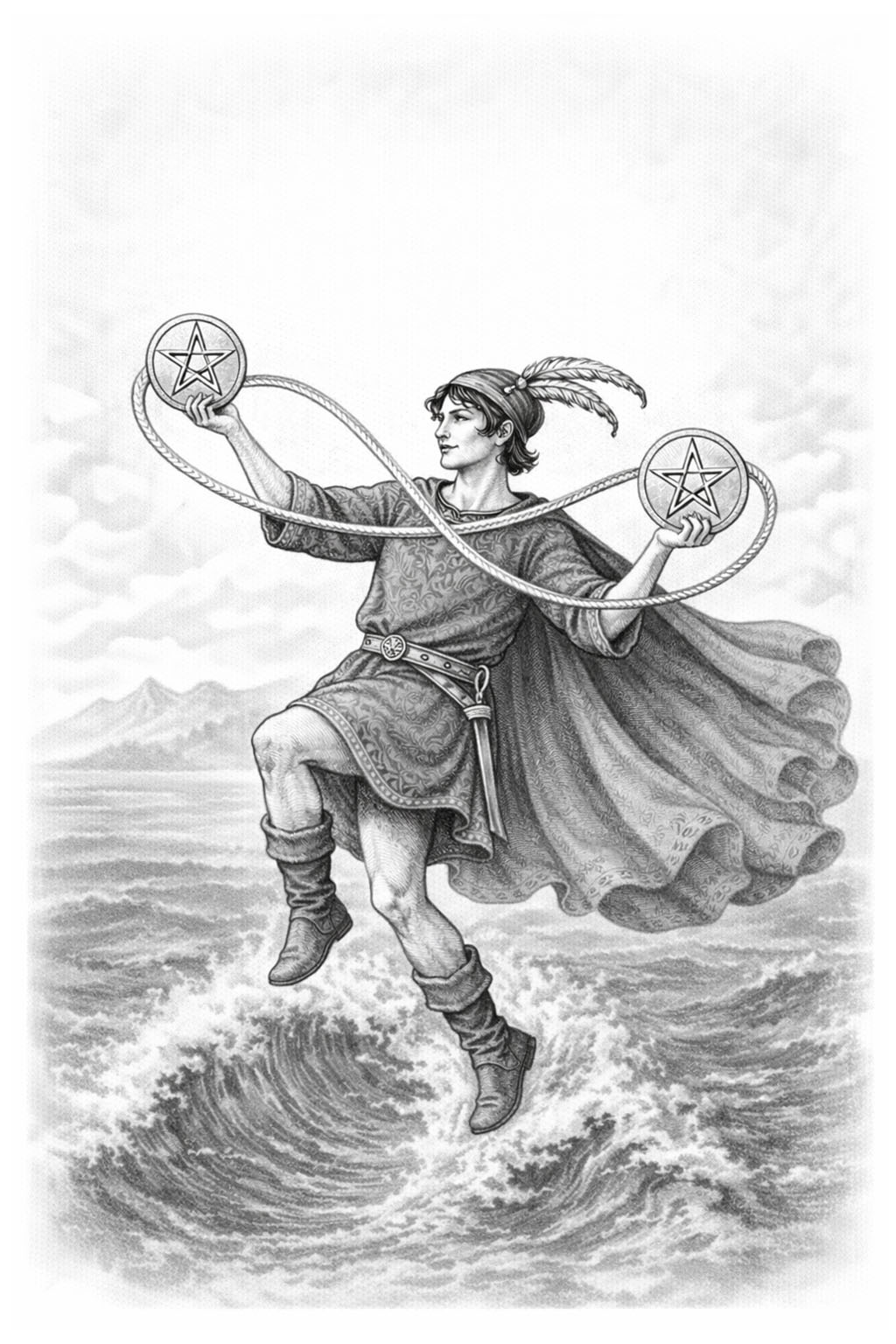
Pentacles Two in a career context emphasizes motion and balance rather than fixed outcomes. The image of juggling coins and the looping ribbon points to a dynamic equilibrium: responsibilities, deadlines, projects, or financial concerns are being actively managed, adjusted and re-prioritized. This card highlights adaptability, responsiveness to shifting conditions, and the practical skills needed to keep several elements in play at once.
Analytically, Pentacles Two suggests that the professional situation involves trade-offs. Time, attention and resources are limited, so reallocations are frequent and decisions about what to emphasize will be ongoing. It can indicate effective multitasking and the ability to pivot when circumstances change, but it also draws attention to the strain of spreading oneself too thin and the risk of dropping important items when the pace increases.
For constructive application, focus on systems that make juggling sustainable: clearer prioritization, regular review of commitments, setting boundaries, and delegating or streamlining tasks where possible. Monitoring cash flow and schedules, negotiating realistic deadlines, and creating simple workflows can reduce the cognitive load the card represents. Seen as an educational prompt, Pentacles Two encourages cultivating flexibility while implementing structures that prevent reactive scrambling, transforming a state of constant adjustment into a manageable rhythm.
meaning.finance
The Two of Pentacles in a financial context highlights the dynamics of balance, fluctuation and resource allocation rather than fixed outcomes. It points to situations where cash flow, expenses or income sources require active juggling—seasonal earnings, multiple part‑time streams, irregular payments or the need to redistribute funds between competing priorities. Symbolically, the card emphasizes adaptability and the skill of maintaining equilibrium under changing conditions; it also draws attention to the cognitive and administrative effort involved in keeping accounts aligned.
Practically, this meaning encourages an analytical approach: track inflows and outflows closely, forecast short‑term variability, and establish simple systems (budget categories, timing of payments, emergency buffer) to reduce the mental load of constant switching. It also implies a risk of overcommitment—taking on too many financial responsibilities or projects can lead to dropped tasks or missed deadlines—so regular review and prioritization are useful. In sum, the Two of Pentacles is a prompt to focus on process and systems that support flexibility and clarity in managing limited resources, rather than a statement about specific financial events.
meaning.family
Pentacles Two (Two of Pentacles) in a family context highlights themes of balance, adaptability and the practical juggling of responsibilities. It describes a dynamic situation in which household members, roles or resources are being managed simultaneously: time, money, caregiving, work and domestic tasks may require continual adjustment. The image of motion and interchange suggests skill at shifting priorities as circumstances change, rather than a static arrangement.
As an analytical indicator, the card points to processes rather than fixed outcomes. It can reflect effective multitasking and resourcefulness when the family adapts to changing demands, finds temporary rhythms, or shares duties flexibly. Equally, it can signal strain when the pattern becomes reactive—energy dispersed across too many demands, commitments left incomplete, or important conversations postponed. The balancing act implies that what holds for a time may need renegotiation as pressures shift.
Practical considerations that arise from this reading focus on clarity and systems: defining who handles what, communicating timing and expectations, and setting boundaries to prevent chronic overload. Attention to simple organizational tools—schedules, transparent budgeting, agreed routines—or periodically reviewing allocations of time and responsibility can stabilize the ebb and flow. Interventions framed as adjustments rather than permanent fixes tend to fit the card’s spirit, acknowledging change while aiming for a sustainable equilibrium.
meaning.mind
The Two of Pentacles, viewed as a psychological state, often describes a mind engaged in active juggling. Cognitively, it suggests someone managing multiple demands, shifting attention between tasks, roles, or responsibilities. This can reflect cognitive flexibility and an ability to adapt quickly to changing circumstances, but it also points to high cognitive load: frequent task-switching, reliance on working memory, and ongoing assessment of trade-offs.
Emotionally, this state can involve oscillation or ambivalence. Feelings may swing between calm competence and underlying tension as priorities compete for limited time and energy. That tension can be experienced as mild stress or a persistent low-level anxiety about maintaining balance, rather than a single acute crisis. Psychologically, people in this state may use compartmentalization or short-term problem-solving to keep things functioning, sometimes at the expense of deeper processing or longer-term planning.
Interpersonal and behavioral patterns associated with this card include multitasking, rapid reprioritization, and a pragmatic focus on immediate resource allocation. Strengths include adaptability, resilience, and the capacity to improvise. Limitations may involve superficial engagement, scattered attention, difficulty sustaining focus on long-range goals, or neglecting self-care because resources are continually redirected outward.
Understanding this state implies noticing whether the juggling is purposeful and manageable or reactive and exhausting. Reflective questions that can clarify the quality of balance include: Which tasks genuinely require equal attention, and which can be deferred or delegated? Where are boundaries porous, and where might setting clearer limits preserve energy? Observing patterns of avoidance, stress accumulation, and the sustainability of current strategies helps distinguish healthy flexibility from a coping mode that will eventually need restructuring or consolidation.
meaning.soul
As a description of an inner state, the Two of Pentacles points to dynamic juggling and ongoing adjustment. Thoughts and feelings move between competing practical demands: responsibilities, roles, material concerns and daily routines. The mind is active and resource-oriented, looking for patterns and rhythms that allow multiple priorities to be managed simultaneously. This can create a sense of nimbleness and improvisational skill, an ability to shift attention and keep things in motion without becoming paralyzed by complexity.
That same flexibility can also have a flip side: emotional fragmentation and a tendency to split attention in ways that feel unstable. Under strain, switching among tasks may feel like balancing on a narrow beam, producing anxiety about dropping something important or losing control. There may be a habit of compartmentalizing feelings to preserve functioning, which helps in the short term but can leave unresolved tension beneath a surface of competence.
From a psychological perspective, the card highlights adaptive coping strategies and their limits. It points to skills in time management, prioritization and creative problem-solving, while also drawing attention to the cost of overcommitment and constant multitasking. Interpreting this state can include considering whether current juggling is sustainable, whether simplification or reallocation of attention would reduce strain, and whether grounding practices might support steadier emotional integration.