Context
meaning.love
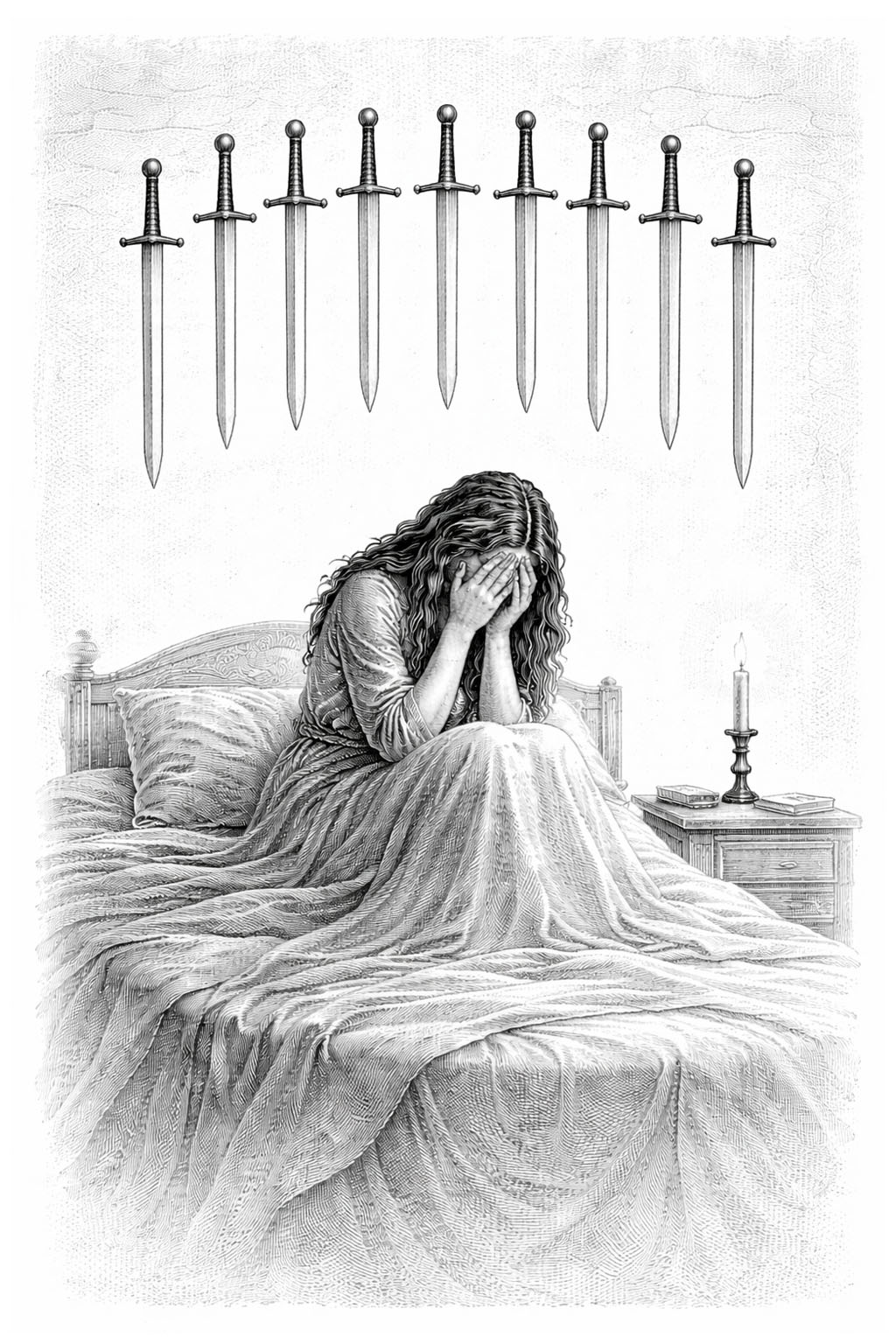
In a love reading, the Nine of Swords points primarily to distress in the mental and emotional sphere rather than concrete changes in the relationship itself. It describes a state of acute worry, replaying painful scenes, insomnia, and a tendency to catastrophize. The card highlights how fear, shame, or unresolved guilt can dominate someone's inner life and spill over into romantic interactions, making situations feel worse than they are or preventing clear conversation.
Symptoms in a partnership often include sleepless nights spent ruminating about arguments, imagined betrayals, unmet expectations, or the future of the relationship. This card can also appear when one partner is carrying secret anxieties or past trauma that colors how they interpret present behavior. Communication may be stilted: one person withdraws or obsesses privately rather than naming fears and inviting a mutual response, which can produce distance and misunderstanding.
Analytically, the Nine of Swords asks you to separate thought patterns from facts. Distress shown by the card is frequently self-generated or amplified by habitual thinking styles—overgeneralization, mind-reading, or selective attention to threats—rather than being a straightforward reflection of a partner’s intent. That distinction matters for deciding how to respond: addressing the cognitive and emotional process will often be more useful than attempting to manage external circumstances alone.
Practical, non-prescriptive approaches that align with the card's message include observing and naming the anxious thoughts, testing assumptions against evidence, and choosing targeted communication about specific concerns rather than airing broad accusations. Personal strategies such as journaling, sleep hygiene, grounding exercises, and professional support for anxiety or trauma can reduce the intensity of internal suffering and make healthier relational choices possible.
The card also invites consideration of responsibility and boundaries: determining what you genuinely need t
meaning.job
The Nine of Swords in a career context points to mental strain more than to an objective professional crisis. Symbolically this card highlights worry, sleepless nights and repetitive thought patterns: anxiety about performance, fear of judgment, guilt over past decisions, or a habit of imagining worst-case scenarios. In practice it often marks a period when someone feels mentally overwhelmed by work demands or is stuck in unproductive rumination that interferes with clear decision-making.
Analytically, the card invites examination of the source and accuracy of the distress. Are deadlines, feedback or organizational changes the real drivers, or are assumptions and internal narratives amplifying them? Distinguishing evidence from fearful speculation helps to reframe problems and prioritize concrete steps. It can also signal burnout, lack of boundaries, or reluctance to communicate concerns, so assessing workload, recuperation needs and the quality of workplace support is useful.
From a practical standpoint, strategies that focus on cognitive clarity and structure are most relevant: document facts, break problems into manageable parts, seek objective feedback or mediation, and create space for rest to reduce cognitive overload. Where anxiety is chronic or paralyzing, professional support—coaching, HR consultation or mental-health services—can improve resilience and decision-making. The Nine of Swords is primarily a map of mental terrain; addressing thinking patterns and information gaps typically yields clearer professional options.
meaning.finance
In a financial reading, the Sword Nine (Nine of Swords) often signals intense mental strain around money—worry, rumination, guilt, and sleepless nights that make financial situations feel overwhelming. It tends to highlight the way anxiety and catastrophic thinking can amplify problems, so that perceived risk or scarcity outpaces the actual, verifiable facts. Psychologically, this card points to thought patterns such as catastrophizing, black‑and‑white thinking, or replaying past mistakes, all of which can produce avoidance, impulsive moves, or paralysis in financial decision‑making. Practically, the image encourages separating emotion from data: gathering account statements, clarifying obligations and deadlines, and breaking complex issues into manageable steps to reduce uncertainty. It also underscores the value of objective perspective—financial advice, mediation, or counselling—to counteract distorted thinking and to negotiate or restructure obligations from a clearer place. Rather than predicting outcomes, the card educates about how inner distress shapes external choices; addressing the emotional drivers of financial behavior and taking measured, evidence‑based steps can restore more balanced problem‑solving and reduce the negative impact of anxiety on financial matters.
meaning.family
The Nine of Swords in a family context points to patterns of mental distress: persistent worry, late-night rumination, guilt or shame about relationships or choices, and a tendency to catastrophize possible outcomes. Because Swords govern the intellect and communication, this card often highlights fears that are mostly experienced internally—thoughts replayed until they feel overwhelming—rather than immediate external danger. In family dynamics this can show up as sleeplessness over conflicts, recurring negative assumptions about others’ intentions, carrying burdens alone, or interpreting ordinary tensions as crises.
Reading this card analytically means examining how worries are produced and maintained: are there unresolved conversations, unclear boundaries, or unexpressed emotions that feed anxiety? It also invites scrutiny of cognitive habits—black-and-white thinking, selective attention to threats, or self-reproach—that amplify normal family stress. Useful areas to explore include improving communication patterns, differentiating evidence from imagined scenarios, and sharing concerns in a way that reduces isolation rather than escalating blame.
Practical approaches consistent with this interpretation include creating safe opportunities for honest, calm dialogue; normalizing and naming specific fears so they can be assessed; and bringing in neutral support when worries overpower day-to-day functioning (for example, counseling, mediation, or mental health resources). The emphasis is on shifting from internal torment to constructive exchange and on recognizing when help is needed to restore balance in family life.
meaning.mind
The Sword Nine commonly reflects a psychological state dominated by the mind’s distress: intrusive worries, sleeplessness, replaying negative scenarios, and a sense of being mentally besieged. Swords symbolise thought processes and cognitive patterns, and the Nine intensifies themes around acute anxiety, guilt, self-reproach and catastrophizing. As a snapshot of inner experience, it points to an overactive inner narrative that amplifies worst-case possibilities, keeps attention fixed on imagined threats, and undermines psychological balance.
This card does not necessarily indicate an accurate appraisal of external danger; rather, it highlights how cognitive distortions—rumination, magnification, all-or-nothing thinking—can generate substantial suffering. The experience it describes is often accompanied by isolation, a reluctance to share distress, and difficulty disengaging from repetitive negative thoughts, which then affect sleep, concentration and mood.
From an educational perspective, the Sword Nine invites examination of thinking patterns and encourages interventions that target cognition and arousal. Techniques such as reality-testing worries against evidence, practicing grounding and relaxation to interrupt nighttime rumination, structuring problem-solving time versus rumination time, and cultivating self-compassion can help shift the pattern. When distress is severe or persistent, professional support from a mental-health practitioner can offer assessment and evidence-based approaches like cognitive-behavioral therapy or brief interventions for insomnia. In symbolic terms, the card points to an opportunity to move from being overwhelmed by thought to developing skills for observing and reframing it, thereby reducing its power over the psyche.
meaning.soul
As a description of a current mental or emotional state, the Nine of Swords points to acute inner distress rooted more in thought patterns than in immediate external events. It commonly represents intense worry, replaying negative scenarios, insomnia or nightmares, feelings of shame or self-reproach, and a sense of being overwhelmed by what feels like unmanageable mental pain. The card highlights rumination and catastrophic thinking: small possibilities are amplified into looming threats, memories or anxieties are repeatedly reviewed, and sleep or rest is disrupted by an active, fearful mind.
Analytically, the image invites examination of cognitive habits that maintain suffering. It asks whether thoughts are being treated as facts rather than interpretations, and whether internal narratives of blame or helplessness are being reinforced through isolation or avoidance. The emphasis is on the quality of attention—attention fixed on worst-case outcomes or past regrets keeps the nervous system in a heightened state.
From an educational perspective, useful responses include practices that differentiate thought from reality, cultivate perspective and reduce arousal. Techniques such as naming specific worries, testing evidence for catastrophic beliefs, setting aside a limited "worry time," grounding exercises to interrupt spirals, improving sleep routines, and seeking compassionate feedback from others can all weaken habitual rumination. If distress is severe or persistent, engaging a mental health professional can provide structured tools for cognitive restructuring and stress regulation. The Nine of Swords, therefore, functions less as a verdict and more as a prompt to bring curiosity, boundary-setting and gentle self-care to an overactive, anguished mind.